
Importing Content
Vidori makes it easy to import content from multiple sources. Whether you’re uploading from your computer, migrating from another platform, or pulling content from social media, we’ve got you covered.
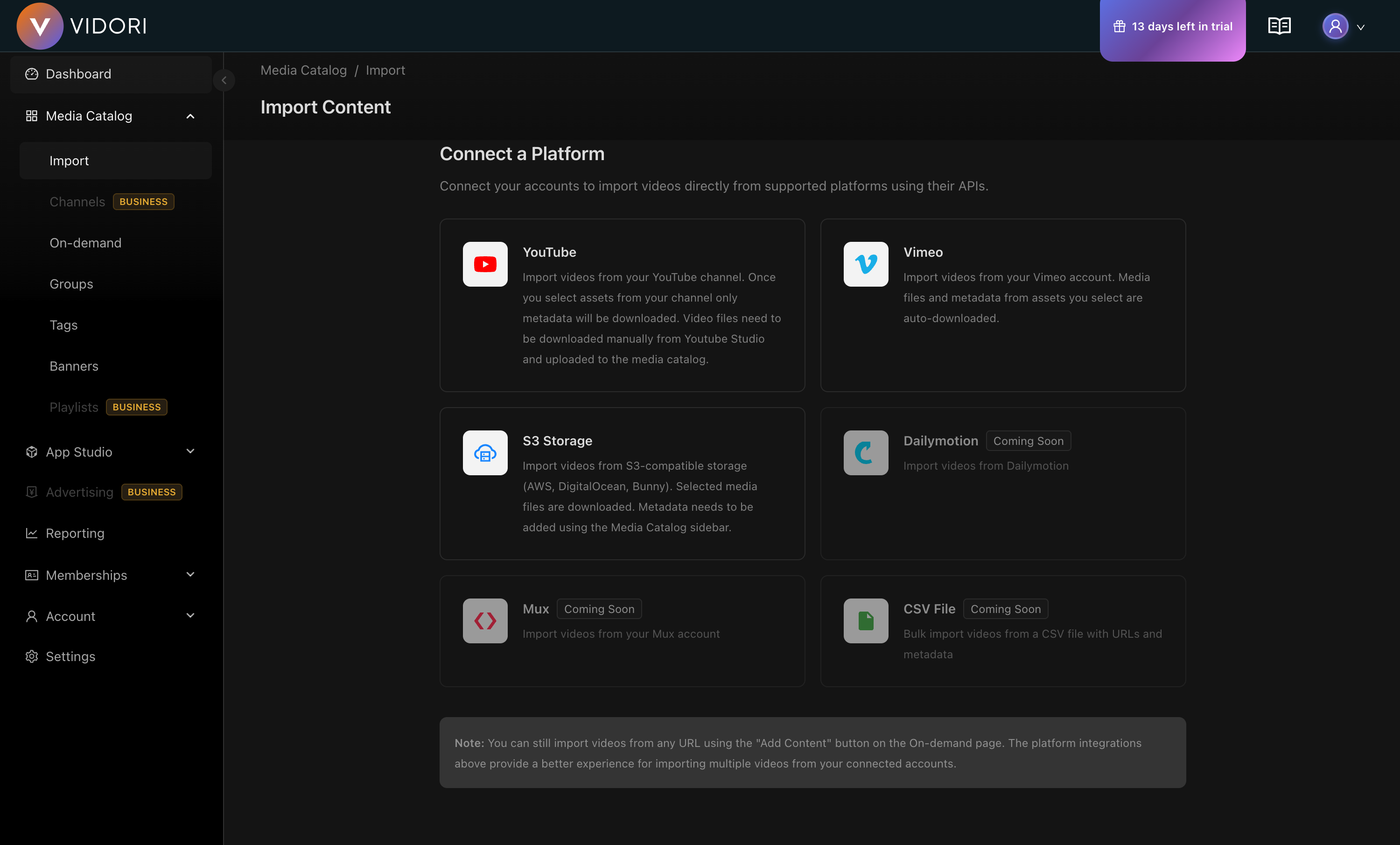
Import Methods
Section titled “Import Methods”Upload video files directly from your computer.
- Go to Catalog → On-Demand
- Click the Import button
- Select Upload Files
- Drag and drop files or click to browse
- Add metadata while uploading (optional)
Supported formats: MP4, MOV, MKV, WebM, AVI
Maximum file size: 10 GB per file (larger files available on Business plans)
Import videos from any supported URL. Vidori supports 100+ platforms including social media, video hosting sites, and news outlets.
- Go to Catalog → On-Demand → Import
- Select Import from URL
- Paste the video URL
- Vidori automatically detects the platform and extracts the video
- Review extracted metadata and click Import
Import videos directly from your YouTube channel with full channel integration.
- Go to Catalog → On-Demand → Import
- Select YouTube
- Connect your YouTube account
- Select videos or entire playlists to import
- Click Import Selected
Automatic extraction includes:
- Video title and description
- Thumbnails (all available resolutions)
- Tags and categories
- Subtitles and closed captions
- Chapter markers (if available)
- Playlist organization
Migrate your Vimeo library to Vidori.
- Go to Catalog → On-Demand → Import
- Select Vimeo
- Authenticate with your Vimeo account
- Choose videos to import
- Metadata and thumbnails transfer automatically
Transferred data:
- Video files in original quality
- Titles, descriptions, and tags
- Custom thumbnails
- Privacy settings (mapped to Vidori equivalents)
- Embedded subtitles
Import from Amazon S3 or S3-compatible storage (MinIO, DigitalOcean Spaces, Cloudflare R2, Backblaze B2).
- Go to Catalog → On-Demand → Import
- Select Amazon S3
- Enter your bucket name and credentials
- Browse and select files
- Configure import settings
Required permissions: s3:GetObject, s3:ListBucket
S3-compatible services:
- Amazon S3
- DigitalOcean Spaces
- Cloudflare R2
- MinIO
- Backblaze B2
- Wasabi
Link an existing HLS or DASH stream directly, without downloading or re-transcoding. This is ideal when your content is already hosted on an external CDN and you want to use it for playback as-is.
- Go to Catalog → On-Demand → Import
- Select Import from URL
- Paste an HLS (
.m3u8) or DASH (.mpd) manifest URL - Vidori detects the manifest format automatically
- The asset is created instantly — no transcoding required
Supported manifest formats:
- HLS — URLs ending in
.m3u8 - DASH — URLs ending in
.mpd
When to use external manifests:
- Your content is already transcoded and hosted on another CDN
- You want to avoid duplicate storage and transcoding costs
- You are aggregating content from multiple CDN sources into a single catalog
- You have live-to-VOD recordings hosted externally that you want to list in your catalog
What Gets Imported
Section titled “What Gets Imported”When importing from external sources, Vidori automatically extracts:
| Data | Description |
|---|---|
| Video file | Full quality source video |
| Title | Original title from source |
| Description | Full description/caption |
| Thumbnails | All available thumbnail sizes |
| Duration | Video length |
| Subtitles | Embedded or associated caption files |
| Tags | Source tags (mapped to your tag taxonomy) |
| Upload date | Original publish date |
Bulk Import
Section titled “Bulk Import”For large content libraries, use bulk import:
- Prepare a CSV file with video metadata
- Go to Catalog → Import → Bulk Import
- Upload your CSV file
- Map CSV columns to Vidori fields
- Start the import process
CSV Format
Section titled “CSV Format”title,description,tags,category,source_url"My Video Title","Video description here","tag1,tag2","Category Name","https://..."Transcoding
Section titled “Transcoding”All imported videos are automatically transcoded to:
- HLS - For Apple devices and Safari
- DASH - For Android and other browsers
- Multiple quality levels - From 360p to 4K (based on source)
Transcoding typically takes 1-2x the video duration.